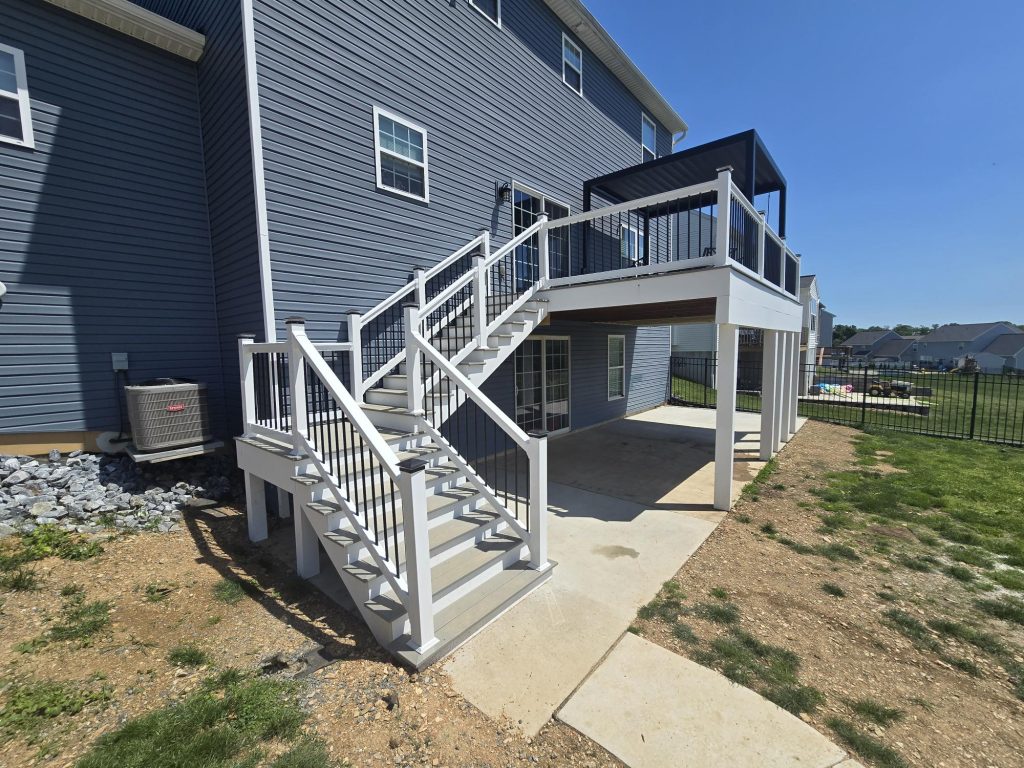
Our Location

Connect with Veteran Deck Builders today to start your dream Deck.

WE ARE OPEN MONDAY-SUNDAY

7:00 am - 7:00 pm

Contact Us

(717) 779-1782

Our Location

23 Kellocks Run Rd, Hummelstown, PA 17036

Custom Deck Builders Serving Harrisburg, PA

We build and rebuild residential decks for homeowners in Harrisburg, Dauphin County, and the surrounding Central Pennsylvania communities. We’re owned and operated by Bud Miller, a retired Army Captain who spent 16 years in the National Guard as an Infantry Battalion Company Commander before turning to construction full-time. That background carries over to how we run a jobsite: materials get staged before the crew shows up, debris doesn’t sit around for a week, and framing gets inspected before anything covers it up.

We operate as HFDH, LLC from 23 Kellocks Run Rd in Hummelstown and hold Pennsylvania Home Improvement Contractor registration PA154450. Our work covers new custom deck construction, structural resurfacing, and covered outdoor spaces, in Trex and TimberTech composite decking, TimberTech Advanced PVC, cedar, and pressure-treated wood, with RDI Finyl Line railing systems.

We’ve completed work in Harrisburg itself, including a 500-square-foot Trex Enhance deck and a larger outdoor-living project that combined an existing 240-square-foot deck with a 96-square-foot extension.
Planning a deck project in Harrisburg? Call us at (717) 779-1782 to arrange a site review and project estimate.

Custom Deck Engineering and Material Selection for Harrisburg Homes

Deck material affects more than looks. It changes how much upkeep you’re signing up for, how it’s fastened, how it expands and contracts, and how hot it gets underfoot in July.
The structure underneath matters just as much, maybe more. A new deck needs concrete footings, posts, beams, joists, a ledger connection, stairs, and guard posts. On a resurfacing job, we only keep what’s there after we’ve checked the framing. New composite boards over rotted joists don’t fix anything, they just hide it.

Composite Decking: Trex and TimberTech

Composite gives Harrisburg homeowners a manufactured surface that skips the staining cycle real wood needs. We've installed both Trex and TimberTech. On a Harrisburg project, we used Trex Enhance Cinnamon Cove across 500 square feet. That job came in at $22,000, about $44 per square foot. Prices move with material costs and site conditions, but that number gives you a ballpark for a similar straightforward build. Composite also works into borders, privacy walls, and stair details. Picture-frame edges hide exposed board ends, and grooved boards can take concealed fasteners that keep screws off the walking surface. The framing underneath still carries the load. Joist spacing, beam spans, post connections, and guard attachment aren't finish work just because the surface is manufactured.

Advanced PVC Decking

PVC decking has no wood in it at all. We've installed TimberTech Advanced PVC on diagonal board patterns, and that layout runs more than a straight one. Cutting boards at an angle wastes more material, needs tighter joist spacing, and takes more labor, so expect the per-square-foot cost to land higher than a standard run. PVC suits homeowners who want a synthetic surface with zero wood fiber. Which product actually fits your project comes down to budget, board profile, color, sun exposure, and what the manufacturer's install specs call for.

Cedar and Pressure-Treated Wood

Real wood is still the right call for homeowners who want it, or where it's doing structural work regardless of what's on the surface. Pressure-treated lumber handles the joists, beams, posts, and stair framing on most of our jobs. Cedar shows up where its look matters, like visible trim or accent features. Wood asks for more upkeep than composite or PVC. It weathers, takes on moisture, splits, and eventually needs refinishing. The connections matter more than the boards. Beam bearing, post hardware, corrosion-resistant fasteners, ledger flashing, and keeping water off the framing are what actually determine how long a wood deck lasts.

Resurface the Existing Deck or Rebuild It?

Resurfacing makes sense when what’s underneath is still sound. We’ve resurfaced decks in the 250- to 300-square-foot range, checking the frame and swapping out decking and railing, and that scope usually runs about three days.
If your joists are rotted, we’re not putting new decking over a framing hazard. A deck moves toward a full rebuild when inspection turns up deteriorated joists, bad beams, damaged posts, a failed ledger connection, or footings that can’t carry the load. We check the frame first, every time, before we decide what stays.

Harrisburg Deck Permits, Footings, and Structural Standards
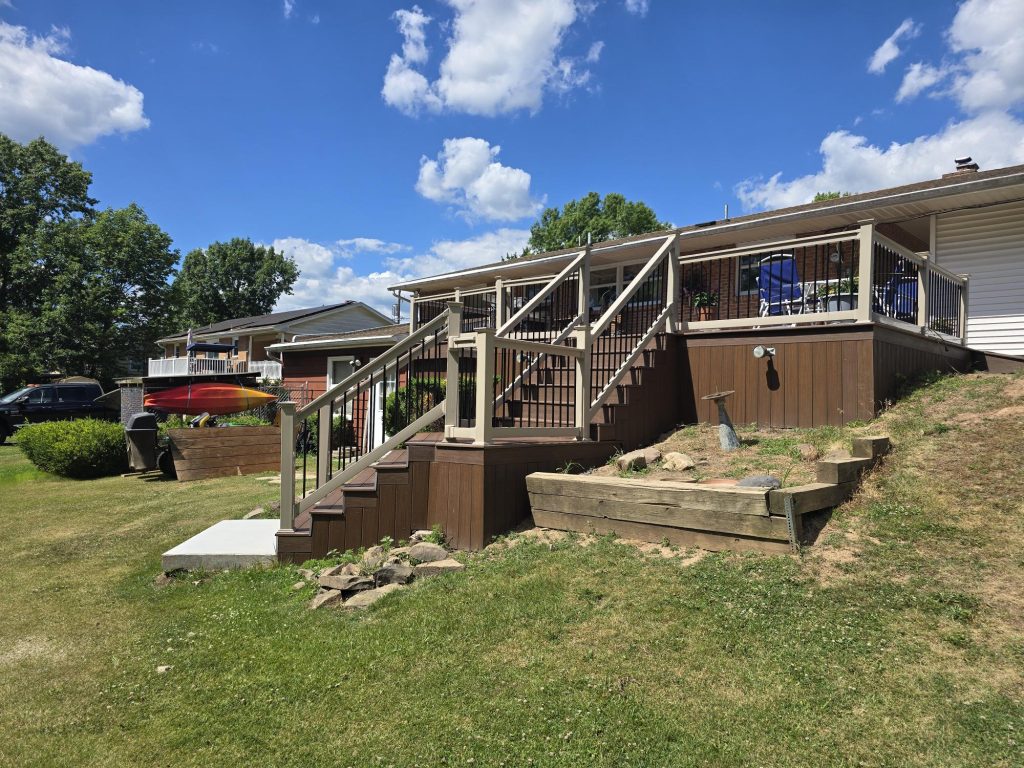
Before construction starts, there are really two questions: what does the property need structurally, and what does the city require for that scope?
The City of Harrisburg Bureau of Codes handles building permits and lists new or replacement exterior decks among the work it regulates. It also publishes deck standards as part of its permit resources.
Deck height changes the permit picture. Under the PA UCC and IRC Section R507 framework, decks built more than 30 inches above grade go through structural plan review and a building permit, with inspection covering footings, joist spans, hardware, stair geometry, guard attachment, and the ledger connection. A low freestanding deck at or below 30 inches can sometimes follow a simpler approval route, depending on footprint, setbacks, and the municipality.
Confirm the jurisdiction before you build. Harrisburg, Hummelstown Borough, Derry Township, and South Hanover Township don’t all run permits the same way.

Footings, Soil, and Frost in Central Pennsylvania

If you’re anywhere near the Swatara Creek basin, you already know the clay soil here doesn’t cooperate. It holds moisture, and when that moisture freezes in winter, it pushes against anything shallow. A footing set too high can heave, and a heaved footing racks posts, twists framing, and on an enclosed room, sticks doors and jams window tracks.
IRC Section R507.3 requires footings sized to carry the load down into the ground, but the exact depth depends on the municipality, its adopted code, and the soil on your specific lot. We confirm that before we dig rather than working off a citywide number. The footing isn’t a separate line item either. It’s carrying everything above it, so it gets sized for the whole structure, not just the hole in the ground.

Covered Decks and Outdoor Living Structures

Add a roof and you’ve changed the structure underneath it. A covered deck carries the deck itself plus roof framing, snow load, and wind, so the posts, beams, footings, and roof-to-house connection all have to size up for it.
We also build porches, screened spaces, three-season rooms, pergolas, and gazebos. Our motorized pergola systems have adjustable louver roofs, drainage built into the posts, and electrical hookups, rated for up to 3,100 pounds of load, 12 inches of snow, and 100 mph wind. Those numbers apply to that specific system, not every pergola we build.

What a Harrisburg Deck Project Involves

Initial Consultation

We start by figuring out what you want and what's already there. On an existing deck, that means deciding whether you're looking at resurfacing, a structural refurbishment, an expansion, or a full replacement. On a new build, we talk footprint, height, access, stairs, material, railing, and any covered sections.

Site Review and Permit Planning

Your address determines which municipality and code office we're dealing with. Plans usually need to show deck dimensions, footing locations, joist direction, beam layout, stairs, and guards. A higher deck, a roof, or an enclosed addition means more structural review than a low freestanding platform, so we confirm permit treatment for your actual parcel rather than assuming it from the mailing city.

Framing and Hardware Specification

We build the load path before a single finish board goes down. Footings carry posts, posts carry beams, beams carry joists, and hardware ties it all together against lateral movement. On an attached deck, the house connection gets the same attention, with fasteners and flashing to match.

Decking and Railing Installation

Straight board runs cut faster than diagonal ones. Borders, breaker boards, stairs, and railing posts all add junctions that need clean termination. We've installed Trex, TimberTech composite, TimberTech Advanced PVC, and RDI Finyl Line railing across our projects.

Final Review and Cleanup

We walk the finished deck with you before we call it done, and the site gets cleaned up as part of the job, not as an afterthought.

Frequently Asked Questions About Deck Building in Harrisburg, PA

The City of Harrisburg Bureau of Codes lists new and replacement exterior decks among the work covered by its permit system. The exact path depends on the deck’s height, attachment, roof, and property conditions. Decks above 30 inches generally trigger structural review under the PA UCC and IRC R507 framework. Confirm the requirements before work starts.
There’s no single depth that applies everywhere. Footings have to meet whatever frost depth and structural requirements the governing authority has adopted for that parcel, and IRC R507.3 requires them sized for the actual load. A covered structure can push that requirement higher than an open deck on the same lot.
Resurfacing keeps the usable parts of the substructure and replaces the worn finish plus anything that fails inspection. A rebuild takes out more of the original structure when the framing, footings, posts, beams, or ledger connection can’t be reused.
Neither one has an exposed wood surface to worry about. Composite is a manufactured wood-plastic blend, and Advanced PVC is fully synthetic. The framing underneath still deals with moisture, freeze-thaw, and fastener corrosion no matter what’s on top, so the material choice comes down to exposure, budget, and how the manufacturer wants it installed.
Depends on the job. Small refurbishments in the 40- to 50-square-foot range have run about two days. Resurfacing in the 250- to 300-square-foot range has taken about three when the existing structure was sound. Custom additions, permits, roofs, tight access, or bad weather push that out, so treat these as reference points, not guarantees.
We start with the actual scope, not a square-foot formula. Framing condition, elevation, stairs, railing, demolition, material tier, site access, and permit work all move the number, so we do a site review before we price anything.
Maybe, but we check it structurally first. The footings, posts, beams, and house attachment may have only ever been sized for an open deck, and once you enclose it, even small footing movement shows up fast, as sticking doors or misaligned window tracks.
We serve the Harrisburg market, but we’re based at 23 Kellocks Run Rd in Hummelstown, PA 17036, operating as HFDH, LLC under PA HIC registration PA154450. Our project record includes multiple completed Harrisburg jobs.

Request a Harrisburg Deck Estimate

A deck estimate should start with your actual project: the footprint you want, the material you’re considering, and the condition of anything already on the property, rather than a square-foot number pulled from a different job.

Veteran Deck Builders HFDH, LLC 23 Kellocks Run Rd Hummelstown, PA 17036
PA Home Improvement Contractor Registration: PA154450 Phone: (717) 779-1782
Scroll to Top